
Thrive Themes








If you strip away the cheerful copy and the conversion charts, Thrive Themes is basically a WordPress company for people who care less about pretty demos and more about getting a page to do a job.
That job is usually simple. Capture an email. Sell a course. Test a headline. Push a visitor from “maybe later” to “fine, I’ll click it.”
That focus shows up in the product line. Almost everything they ship is tied to conversion behavior, not design fashion.
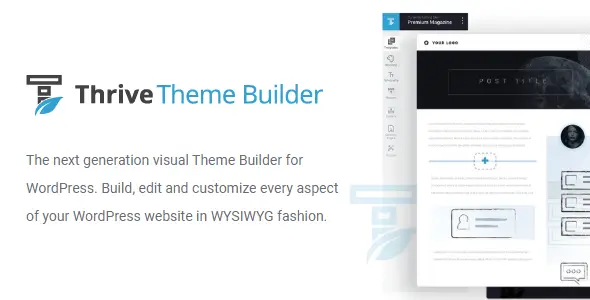
The core of the stack is Thrive Architect and Theme Builder. Architect is the visual page builder. Theme Builder handles site-wide templates like headers, footers, blog layouts, and post templates. On paper, that sounds like every other WordPress builder combo. In use, the difference is the bias. The blocks, templates, and controls are built around landing pages, lead magnets, launch pages, webinar registrations, pricing sections, testimonials, and calls to action. Not around making your agency portfolio feel “premium.”
That matters more than people admit.
A lot of WordPress tools can make a nice page. Fewer are opinionated about what should happen next on that page.
Then you get the plugins. Thrive Leads is for opt-in forms and list building. It is powerful, but it is also the product most likely to make you feel the weight of the suite. If you go wild with popups, ribbons, slide-ins, and targeting rules, you can feel it. It is not the lightest option in WordPress. Useful? Yes. Invisible? No.
Thrive Quiz Builder is one of those tools that sounds gimmicky until you actually need segmentation. If you run a site where different visitors need different offers, quiz funnels make sense fast. The plugin is less about “fun content” and more about routing people into the right bucket.
Thrive Comments takes the default WordPress comment area and turns it into something closer to a small engagement engine. You can trigger follow-up actions after a comment, which is smart. Most site owners ignore that moment completely.
Thrive Optimize adds A/B testing for pages built in Architect. This is one of the cleaner parts of the ecosystem because it stays close to the builder instead of turning split testing into a separate science project. Change a page, run the test, pick a winner. Nothing shocking on paper. Very practical in real work.
Thrive Ovation handles testimonials. Normally I would roll my eyes at a dedicated testimonial plugin, but collecting, approving, tagging, and reusing social proof in WordPress is messier than it should be. Ovation fixes a boring problem. Good products often do.
Thrive Ultimatum is their scarcity campaign tool. Timers, fixed-date promos, evergreen countdowns, launch windows. It can be effective. It can also become the fastest path to making your site look like a late-night infomercial if you have no restraint.
Thrive Apprentice is the course builder. It is better than many people assume, but it is still best understood as “good course delivery inside WordPress,” not a full replacement for every dedicated learning platform under the sun. If your business lives and dies by deep LMS features, you need to compare carefully. If you want to publish structured lessons, lock content, and sell access without stitching five random plugins together, it makes sense.
There is also Thrive Automator, which is their automation layer. Helpful. Not magical. It reduces glue work between plugins and basic site actions. If you already live in WordPress automation land, you will understand the value immediately.
My honest read on Thrive Themes is this: it is strongest when one person or a small team wants one coherent system instead of a pile of “best-in-class” plugins from six vendors. That is the real pitch, even if they do not always phrase it that way.
The trade-off is obvious too.
You are buying into an ecosystem. A fairly tight one. That means better internal fit, but also less freedom than the more modular WordPress route. Some users love that. Some start feeling boxed in after a year.
It is also not the toolset I would pick for every site. If the project is content-heavy, ultra-fast, minimal, and mostly editorial, parts of the suite can feel like overkill. If the project is conversion-first, launch-driven, and built around offers, forms, tests, and funnels, the logic of Thrive Themes becomes very easy to understand.
So no, this brand is not “for everyone.” Good. Most software gets worse when it tries to be.
What they actually sell is clarity.
Build the page. Add the form. Run the test. Collect the proof. Launch the offer. Tune the funnel. Repeat.
If that workflow sounds familiar, Thrive Themes will feel unusually coherent. If it doesn’t, you may end up paying for a lot of machinery you never really use.